
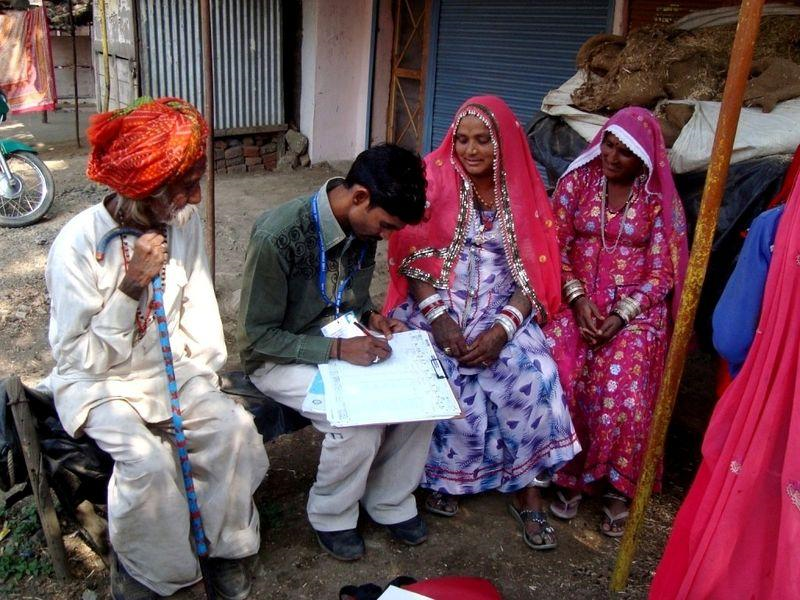
 Somya Sharma, Qualitative Researcher, Outline India
Reliable research begins with asking the right questions. Whether an organisation is evaluating an education programme, studying agricultural households, assessing public health initiatives or measuring social outcomes, the quality of its findings depends on the quality of its research tools. Survey instrument development is the process of translating research objectives into structured questionnaires, assessment tools and interview guides that collect relevant, consistent and usable information.
A well-designed instrument does more than list questions. It considers who will answer them, how concepts will be understood, which indicators need to be measured, how responses will be recorded and how the resulting data will be analysed. For research across different communities and languages, translation, cognitive pre-testing and field piloting are equally important.
· 1. What Is Survey Instrument Development?
· 2. Why Is Questionnaire Design Important?
· 3. Key Components of an Effective Survey Instrument
· 4. How to Develop a Survey Instrument: Step-by-Step
· 5. Translation and Cultural Adaptation
· 6. Cognitive Pre-Testing and Field Piloting
· 7. Real Project Examples from Outline India
· 8. Common Mistakes to Avoid
· 9. Instrument Development vs Data Collection
· 10. Why Work with Outline India?
· 11. Frequently Asked Questions
· 12. Conclusion and CTA
Survey instrument development is the systematic process of designing, structuring, testing and refining tools used to collect research data. These tools help researchers gather information that directly addresses a study's objectives and indicators.
A survey instrument can include:
Structured questionnaires for quantitative research.
Semi-structured interview guides for qualitative research.
Focus group discussion (FGD) guides.
Observation checklists.
Knowledge, attitude and practice (KAP) assessment tools.
Educational assessments and measurement scales.
Household and community survey schedules.
The instrument must reflect the research questions, target population, study design and intended analysis. An education assessment measuring foundational literacy needs tasks that capture children's reading and comprehension abilities. A household survey examining agricultural practices requires a different structure, respondent approach and set of indicators. Survey instrument development connects research design with the practical requirements of collecting meaningful information.
Questionnaire design influences what respondents understand, how they answer and whether the collected information can be used for analysis. Poorly worded questions, unclear response options, unsuitable translations or incorrect skip patterns can introduce measurement errors and missing information.
Effective questionnaire design helps organisations:
Measure research indicators consistently.
Collect information relevant to programme objectives.
Reduce ambiguity and respondent burden.
Improve comparability of responses.
Support accurate data analysis.
Make field implementation easier for enumerators.
Identify problems before large-scale data collection begins.
Every question should connect to a research objective, evaluation question or indicator. Identify the target population, variables and exact information required before drafting questions. For an agricultural household survey, topics may include cropping patterns, agricultural inputs, income sources, access to services and farming challenges.
Group related questions into logical modules. A household survey may include respondent identification and consent, household composition, education and employment, income and expenditure, agricultural activities, access to services and closing questions.
Questions should be clear, neutral and appropriate for the target population. Avoid leading, double-barrelled or overly technical questions. Ask separately about changes in household income and employment rather than combining both in one question.
Use response options that are relevant, mutually exclusive wherever appropriate and sufficiently comprehensive. Options may include Yes/No, multiple choice, frequency scales, Likert scales, numeric responses and open-ended questions.
Skip logic determines which question a respondent should answer next. If a respondent does not cultivate crops, crop-specific expenditure questions may not apply. Instructions should explain when to ask, skip and record each question.
Collect the information needed without placing unnecessary demands on respondents. Excessively long instruments can increase fatigue, interruptions and incomplete responses. Remove questions that do not contribute to the study objectives or analysis.
Review the study objectives, research questions, evaluation framework and expected outputs. Identify the target population, units of analysis, indicators and information requirements.
Review relevant questionnaires, validated scales and previous research instruments. Adapt them to the study context rather than copying without review. Document the source of adopted questions and any modifications.
Map each research objective to its indicators, variables, questions and response formats. This helps ensure coverage without unnecessary questions.
Arrange questions into logical sections, beginning with introductory and consent information. Include instructions, definitions, response options and skip patterns.
Check clarity, relevance, neutrality, recall requirements, respondent suitability and whether response options cover likely answers.
Translate into the languages required for fieldwork and review meaning, context and consistency rather than relying only on word-for-word translation.
Test whether potential respondents understand questions as intended. Cognitive interviews can identify confusing terms, difficult recall and differences in interpretation.
Administer the draft instrument under field conditions with respondents similar to the target population. Review flow, duration, skip logic, protocols and data recording.
Use pre-test and pilot feedback to revise the questionnaire, resolve issues and prepare the approved version for field implementation.
Record the final questionnaire version, language versions, revisions and approval status so field teams use the correct instrument.
Research objective | Indicator | Example question | Response type |
Understand education access | School attendance | Did the child attend school during the previous week? | Numeric / frequency |
Assess agricultural practices | Crop diversification | Which crops did your household cultivate during the last agricultural season? | Multiple choice |
Understand service access | Service utilisation | Have you accessed the service during the last six months? | Yes / No |
Research across Indian states and diverse communities often requires questionnaires in multiple languages. Literal translation alone does not establish conceptual equivalence. A question may be grammatically correct yet fail to communicate the same idea in the respondent's local context.
Context review: Identify terms and concepts that may not translate directly.
Translation: Use translators familiar with the research subject.
Independent review: Check accuracy, clarity and consistency.
Conceptual adaptation: Use locally understandable wording without changing intended meaning.
Pre-testing: Check whether respondents interpret translated questions as intended.
Documentation: Record translation decisions and revisions.
Back-translation can be an additional quality check, but it should not replace respondent testing or expert review. The objective is to maintain what a question measures across languages while making it understandable to respondents.
Cognitive pre-testing examines how respondents understand and answer questions. Researchers may ask respondents to explain what a question means, how they arrived at an answer or whether wording was difficult. It can identify ambiguous phrases, difficult recall periods, sensitive questions and unsuitable response options.
A field pilot tests the questionnaire under conditions similar to the actual survey. It helps assess interview duration, question sequencing, skip logic, enumerator instructions, respondent availability, translation clarity, data recording and field logistics.
Aspect | Cognitive pre-testing | Field piloting |
Purpose | Understand interpretation of questions | Test the complete survey process |
Focus | Meaning and comprehension | Administration, timing, flow and logistics |
Approach | Individual cognitive interviews | Small-scale field administration |
Output | Question-level improvements | Instrument and field protocol improvements |
Benefit | Identifies interpretation problems | Identifies operational problems |
Both approaches can strengthen an instrument. The appropriate combination depends on the research design, target population, data collection mode and project requirements.
Our work across education and agriculture demonstrates how survey instruments and assessment tools support research objectives in different contexts.
In the Pilot Agricultural Household Survey in India, Outline India is working with Monash University to test and refine the methodology, tools and operational procedures for the forthcoming India Agricultural Household Survey 2026. The pilot covers 100 agricultural households across four villages in Uttar Pradesh and Bihar, focusing on farmers whose primary production centres on wheat or potato.
Responsibilities include reviewing and translating the quantitative survey tool, CAPI programming, household listing, sampling, field team recruitment and training, data collection, sample collection, data management and quality checks.
Pilot Agricultural Household Survey in India
Outline India partnered with an American fund as a data collection partner for a study examining reading fluency and numerical abilities among children in Grades 2 and 3 across Jharkhand and Uttar Pradesh. The study involved 6,900 respondents from 690 schools across six districts and included baseline, midline and end-line studies. It demonstrates why assessment tools must align with the specific abilities being measured and the age group of respondents.
Foundational Literacy and Numeracy Assessment
In collaboration with Bharti Foundation, Outline India developed tools for the impact assessment of robotics labs and digital classrooms in Satya Bharti Schools in Delhi and Punjab. The tools captured students' coding and programming skills, life skills such as creative thinking, problem-solving and collaboration, and teachers' use of digital content.
Impact Assessment of Robotics Labs and Digital Classrooms
Common mistake | Why it matters | Recommended approach |
Drafting without clear indicators | Questions may not answer research objectives | Map questions to indicators |
Leading or double-barrelled questions | Responses become difficult to interpret | Use neutral, single-focus questions |
Translation without contextual review | Meaning may change across languages | Review and pre-test translated versions |
Ignoring skip logic | Respondents may answer irrelevant questions | Test all questionnaire pathways |
Skipping cognitive pre-testing | Comprehension issues remain undetected | Test with potential respondents |
Not conducting a field pilot | Operational problems emerge during rollout | Pilot under field conditions |
Unrecorded changes | Teams may use inconsistent versions | Maintain version control |
Survey instrument development and data collection are connected stages of a research project, but they serve different purposes.
Survey instrument development | Data collection |
Defines what information needs to be collected | Collects information from respondents |
Develops questionnaires and assessment tools | Administers approved tools |
Establishes wording and response options | Records responses |
Reviews translation, comprehension and skip logic | Implements field protocols |
Includes pre-testing and piloting | Includes supervision and data quality checks |
Produces a final research instrument | Produces the collected dataset |
Explore Outline India's data quality practices to understand how quality checks are integrated into the research cycle.
We are a field research organisation supporting research, data collection, monitoring and evaluation across diverse sectors and geographies.
Over 13 years, we have completed more than 1,400 studies and 600 evaluations with 1,000+ partners. Our field teams work across 27 states and 4 Union Territories. We have reached over 5 million respondents in more than 2 lakh villages, and we work in 30+ Indian languages. Governments, CSRs, foundations, universities and AI companies rely on us to bring grassroots realities into their decisions.
Survey instrument development: We support the review and development of research tools aligned with study objectives and indicators.
Qualitative and quantitative research: We support different research approaches, including structured surveys and qualitative data collection.
Translation and adaptation: We support the review and translation of survey tools for diverse field contexts.
Field implementation: Our field teams support respondent engagement and survey administration across locations.
Data quality: We use enumerator training, field practice, spot checks, back-checks and data monitoring to support reliable data collection.
End-to-end research support: We work across tool review, field preparation, implementation and data management.
Explore our research tools and survey instrument capabilities or learn more about our research projects.
Survey instrument development is the process of designing, reviewing, translating, testing and finalising tools used to collect research data. These tools may include structured questionnaires, interview guides, assessment tools and observation checklists. The process begins with research objectives and indicators, then moves through question drafting, response option design, translation, cognitive pre-testing and field piloting. Its purpose is to ensure that the instrument collects relevant information in a clear and consistent manner.
The main steps include understanding research objectives, reviewing existing tools, identifying indicators, drafting questions, organising questionnaire modules, designing response options and skip logic, translating the instrument, conducting cognitive pre-testing, piloting it in the field and finalising the approved version. Version control is also important so that researchers and enumerators use the correct instrument during implementation.
Pre-testing helps identify problems before a questionnaire is used in a larger survey. It can reveal unclear wording, confusing response options, difficult recall requirements, unsuitable question sequences and problems with skip instructions. Cognitive interviews help researchers understand how respondents interpret questions, while field pilots examine how the instrument works during actual administration. Addressing these issues early can improve questionnaire usability and the quality of collected information.
Cognitive testing focuses on how respondents understand and answer individual questions. It helps identify ambiguous wording, unfamiliar terms and differences in interpretation. Pilot testing examines the questionnaire and survey procedures under field conditions. It assesses interview duration, question flow, skip logic, enumerator instructions and implementation challenges.
Translation affects whether respondents in different language groups understand questions in the intended way. Literal translation may not preserve local meaning, context or commonly used expressions. A quality-focused process includes translation, independent review, contextual adaptation and respondent pre-testing. Back-translation may provide an additional check, but it does not replace testing with potential respondents.
Effective survey instrument development connects research objectives with the questions asked in the field. A structured process involving indicator mapping, questionnaire design, translation, cognitive pre-testing, piloting and version control helps researchers identify potential problems before full-scale data collection.
For studies involving different communities, languages and research settings, these steps are essential to collecting consistent and meaningful information. Organisations planning surveys, assessments or evaluations should treat questionnaire development as a core part of research design, not simply as a preliminary administrative task.
At Outline India, we support research teams with survey instrument review, translation, field implementation and data quality practices across diverse research contexts.
Planning a survey, assessment or research project? Contact Outline India's research team to discuss your questionnaire design, survey instrument development and field research requirements.



David Angel Makel
IT ConsultantIt is a long established fact that a reader will be distracted by the readable content page looking at its layout point of using normal