
 Somya Sharma
NGOs, corporate social responsibility (CSR) teams, foundations and development organisations need more than activity counts to understand whether a programme is making a difference. A training programme may reach hundreds of people, for example, but decision-makers also need to know whether participants gained skills, found relevant work and sustained improvements in income. Impact assessment helps answer these questions by examining what changed, for whom, under what conditions and what the available evidence can reasonably establish.
Choosing an impact assessment agency in India is both a methodological and operational decision. The right partner understands the programme, selects a defensible design, reaches communities, protects participants and turns findings into recommendations.
Impact assessment services are structured research activities used to examine the significant intended and unintended changes associated with a programme, policy or intervention. Depending on the question, an assessment may investigate outcomes in education, health, livelihoods, gender equality, agriculture, financial inclusion, water, sanitation and hygiene (WASH), or other development areas.
The scope can include evaluation design, theory of change, sampling, baseline and endline studies, surveys, interviews, FGDs, administrative data analysis, field observation and reporting. Depending on the design, an assessment may describe change or estimate causal effects.
A well-defined framework distinguishes reach and outputs (who was engaged and what was delivered) from outcomes (changes in knowledge, behaviour, access, income or well-being) and longer-term effects. It should also examine equity, unintended consequences and sustainability. Indicators must be relevant to the programme: a school intervention may measure learning and attendance, while a livelihood programme may examine job quality, earnings and employment retention.
For NGOs, evaluation can identify whether an intervention addresses the needs it was designed for, which groups are benefiting and where delivery needs to improve. For CSR teams, it can connect programme expenditure and implementation with outcomes that matter to communities and corporate decision-makers. Government agencies and development partners can use findings to compare implementation across locations, improve service delivery and inform resource allocation.
Impact assessment supports accountability to participants, funders and partners. It distinguishes outputs—such as people trained—from outcomes such as improved skills, service use or household resilience. Findings are most useful when questions are agreed early and evidence is designed around decisions.
Monitoring is the routine tracking of activities, outputs and indicators during implementation. Programme evaluation examines a programme’s relevance, performance, implementation and results. Impact evaluation asks whether, and to what extent, an intervention caused a change, using a design capable of estimating a credible counterfactual where feasible.
The OECD Development Assistance Committee’s six evaluation criteria—relevance, coherence, effectiveness, efficiency, impact and sustainability—provide a useful framework for framing evaluation questions. They should be applied thoughtfully and adapted to the intervention, rather than treated as a checklist that every study must address in equal depth. Read the OECD guidance on applying the six criteria.
A baseline establishes conditions before or near the start of an intervention. A midline examines progress during implementation and can identify delivery barriers while there is still time to respond. An endline measures outcomes at the close of a defined period, often using indicators and tools aligned with the baseline. Consistency in definitions, sampling and measurement is essential if results are to be compared meaningfully across rounds.
When decision-makers need to estimate causal effects, an evaluator may consider randomised assignment or quasi-experimental approaches such as difference-in-differences, regression discontinuity or matching. The choice depends on how participants entered the programme, available data, implementation conditions, ethical considerations and the decision the study must inform. Experimental or quasi-experimental methods should not be presented as automatically suitable for every programme.
Social impact assessment examines how an intervention or development activity affects people and communities, including access, inclusion, livelihoods, local institutions and possible adverse effects. Process evaluation examines how a programme is delivered: whether intended activities reach the right groups, how implementation varies by location and which contextual factors support or constrain delivery.
For difference-in-differences, the evaluator should examine whether treatment and comparison groups followed parallel trends before the programme. A sample-size plan should include power calculations and the minimum detectable effect (MDE), accounting for outcome variability, clustering and sample design. Attrition between survey rounds can reduce power and introduce bias if those lost to follow-up differ from those retained. The study should plan respondent tracking and assess attrition. It should also consider contamination or spillovers, where comparison-group members receive or are indirectly affected by the intervention.
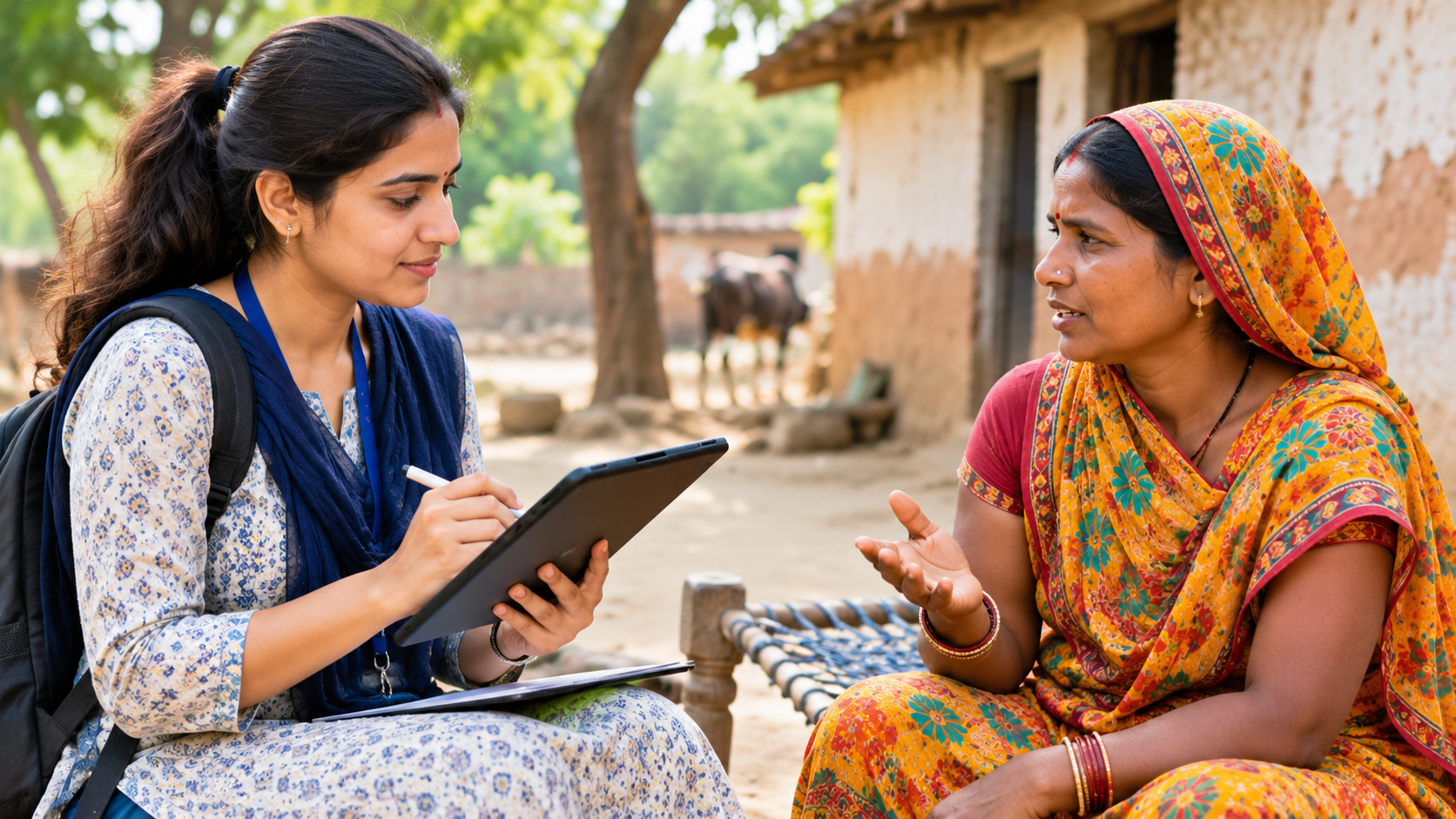
Field research may include household and individual surveys, structured interviews, focus group discussions, key informant interviews, observation, tool development, translation, enumerator training, field supervision, data validation and documentation.
Additional field support may include rapid assessments, CAPI programming and coding, audio audits, village mapping, translation and transcription, UX and human-centred design (HCD), and narrative building.
Structured surveys and administrative data can measure outcomes consistently across respondents or locations. Randomised controlled trials allocate eligible units to treatment and comparison groups by chance, where this is feasible and ethical. Quasi-experimental methods construct a comparison using observational data or programme rules. Difference-in-differences compares changes over time between programme and comparison groups; its central identifying assumption is that, without the programme, the groups would have followed parallel trends. Pre-programme trend evidence should therefore be examined, and the assumption stated transparently.
In-depth interviews, FGDs, observation and document review explain how participants experience a programme and why results may differ across groups. Mixed-methods designs integrate these insights with quantitative findings. Where a credible counterfactual is not feasible, contribution analysis tests the programme’s theory of change against evidence and alternative explanations. Process tracing examines whether the expected causal mechanisms and intermediate steps are supported by evidence in a particular case. These approaches strengthen understanding of contribution; they should not be described as equivalent to a precise experimental estimate of causal impact.
For a practical introduction to counterfactuals, evaluation design, sampling and implementation, see the World Bank and Inter-American Development Bank handbook, Impact Evaluation in Practice.
Look for experience with comparable research questions, population groups, sectors and geographies. Ask for project examples and clarify the agency’s precise role—design, field implementation, analysis or a combination. A published project reference should be described accurately and should not imply responsibilities or results that the organisation did not deliver.
A strong proposal should set out the evaluation questions, theory of change, indicators, sampling frame, sample-size rationale, data collection tools, analysis plan and limitations. For causal evaluation, ask how the comparison group will be selected, what assumptions are required and how threats to validity will be assessed. The agency should explain why the proposed design is proportionate to the question, budget and available evidence.
Ask how enumerators are recruited, trained and supervised; how local languages and sensitive topics are handled; and how non-response is recorded. Quality procedures may include tool piloting, field practice, spot checks, back-checks, audio audits where consented and appropriate, high-frequency data review, logic checks and documented cleaning. Clarify escalation procedures for inconsistencies, safeguarding concerns and field deviations. Outline India’s data quality approach describes training, spot checks, back-checks and daily data review.
The agency should explain how it will obtain informed consent, protect confidentiality, minimise harm, manage sensitive information and respond to safeguarding concerns. Data collection and processing should be planned in line with applicable Indian data-protection requirements, including the Digital Personal Data Protection Act, 2023, and relevant rules and commencement notifications. The project team should confirm which provisions are in force and applicable at the time of the study.
For biomedical and health research involving human participants, the ICMR National Ethical Guidelines (2017) provide a key reference. Where applicable, the study protocol should be reviewed by an appropriately constituted Ethics Committee and approval obtained before participant recruitment or data collection. Studies involving children or vulnerable groups may require additional safeguards and age-appropriate consent or assent.
Confirm the scope of work, geographic coverage, respondent targets, milestones, review rounds, data formats, codebooks, cleaned datasets, report structure, presentation requirements and itemised costs. Check whether translation, transcription, travel, piloting, supervision, data processing and taxes are included. The lowest quotation may not provide the level of field oversight or analysis required; compare like-for-like scopes.
Outline India’s “Impact Assessment of Phase 2 of the Gender Empowerment through Integrated Menstrual Hygiene Management Initiative” was commissioned by the Centre for microFinance (CmF), Jaipur. The assessment covered Rajasthan, Assam, Andhra Pradesh and Jharkhand.
The published project description reports 1,700 quantitative surveys and 32 qualitative interactions: eight focus group discussions and 24 key informant interviews with ASHAs, Anganwadi Workers, teachers, Medical Officers and programme staff. This combines structured survey evidence with perspectives from frontline workers and implementation stakeholders. Project details: https://www.outlineindia.com/our-work-single/116.
Start by identifying the decision the study must support—programme redesign, expansion, funding allocation, accountability or organisational learning. Convert this purpose into answerable evaluation questions and map the theory of change, including assumptions and external influences. Select indicators with clear definitions, denominators and disaggregation requirements. Then choose a design and sampling strategy that are feasible and ethically appropriate.
Before fieldwork, finalise tools, translations, consent materials, data protocols and required ethics approvals. Pilot instruments, train field teams and document implementation deviations. In analysis, report uncertainty, missing data, subgroup differences and limitations. Translate findings into prioritised recommendations, owners and timelines.
At Outline India, we are a field research organisation providing primary data collection, monitoring and evaluation, impact assessments and evidence-led research to support programme decisions.
Our capabilities include research framework development, survey design, quantitative and qualitative research, rapid assessments, CAPI coding, audio audits, village mapping, translation, transcription, dataset development, UX research, Human-Centred Design (HCD) and narrative building.
Our work is supported by enumerator training, field supervision, spot checks, back-checks, digital data monitoring and quality checks.
Over 13 years, we have completed more than 1,400 studies and 600 evaluations with 1,000+ partners. Our field teams work across 27 states and 4 Union Territories. We have reached over 5 million respondents in more than 2 lakh villages, and we work in 30+ Indian languages. Governments, CSRs, foundations, universities and AI companies rely on us to bring grassroots realities into their decisions.
Our four-state MHM assessment, covering 1,700 surveys and 32 qualitative interactions, demonstrates our experience in multi-state field research and mixed-methods studies.
Explore our What We Do, Data Quality and Fieldworker pages to learn more about our capabilities.
They are research and evaluation services used to examine changes associated with a programme or intervention. Depending on the purpose, they may include study design, sampling, surveys, qualitative research, fieldwork, analysis and recommendations. The design determines whether the study describes outcomes, assesses contribution or estimates causal effects.
Compare relevant experience, methodology, sample design, field reach, data-quality systems, ethics, privacy, deliverables, timelines and cost. Ask the agency to explain its assumptions and limitations and to provide examples that accurately reflect its role.
A baseline-to-endline comparison can document change in measured indicators. On its own, it does not establish that the programme caused that change. Causal conclusions require a suitable design that addresses plausible alternative explanations.
Methods include surveys, administrative data analysis, interviews, FGDs, observation, mixed-methods research, randomised evaluations and quasi-experimental approaches. Contribution analysis and process tracing can help examine how a programme plausibly contributed to outcomes when a counterfactual estimate is not feasible.
Costs depend on research questions, sample size, locations, travel, languages, field duration, survey mode, ethics, analysis and deliverables. Request an itemised proposal based on a defined scope.
A useful impact assessment is built on clear questions, an appropriate design, careful field implementation, ethical research and transparent interpretation. When selecting an agency, examine not only its portfolio but also how it will sample, train, supervise, protect participants, validate data and explain uncertainty. The aim is not to promise a positive result; it is to produce credible evidence that helps organisations understand what is working and what should change. For related guidance, read our guide to choosing a data collection agency in India
Discuss your programme objectives, target population, locations and evidence needs with Outline India. Explore our related CSR impact assessment guide, data quality practices and field team network, or contact our research team to scope an


David Angel Makel
IT ConsultantIt is a long established fact that a reader will be distracted by the readable content page looking at its layout point of using normal