
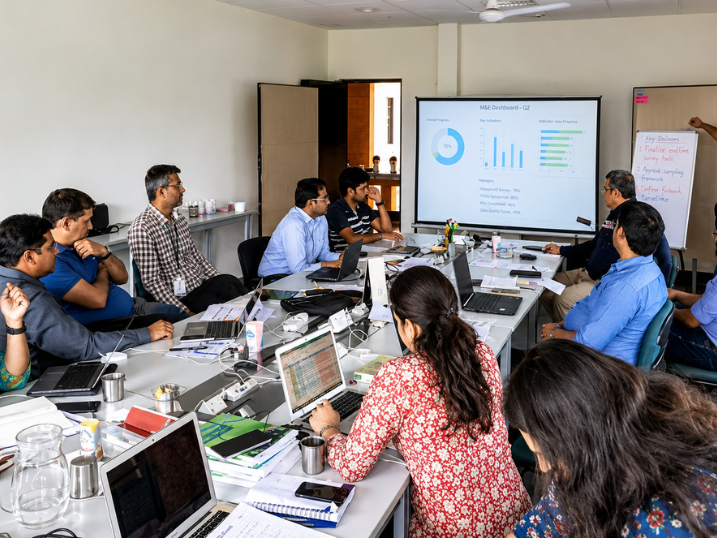
India's development sector has matured considerably over the past two decades, with increased emphasis on evidence-based programming, accountability to beneficiaries, and rigorous measurement of social outcomes. As government schemes scale nationally and philanthropic capital flows toward high-impact interventions, the demand for credible monitoring and evaluation (M&E) has intensified. Program officers at multilateral agencies, foundation directors overseeing multi-year grants, and CSR heads managing corporate social investments now routinely commission independent evaluations to assess program effectiveness, inform course corrections, and demonstrate impact to stakeholders.
Outline India, founded in 2012, is a data-driven research firm that conducts monitoring and evaluation, primary data collection, and impact assessment for the development sector across India. With field infrastructure spanning 27 states and 4 union territories, sectoral expertise across health, education, livelihoods, WASH, and governance, and a methodological approach grounded in international evaluation standards, Outline India serves as an M&E partner to foundations, government agencies, and corporate social responsibility programs.
This article outlines the scope of monitoring and evaluation in India's development context, describes Outline India's M&E capabilities and methodological approaches, and provides guidance for organizations seeking to commission rigorous, large-scale evaluations that meet donor and government standards for evidence quality.
What Monitoring and Evaluation Firms Do in India's Development Sector
Monitoring and evaluation are distinct but complementary functions within program implementation. Monitoring refers to the ongoing, systematic collection of data on program inputs, activities, outputs, and early outcomes. It answers operational questions: Are activities being implemented as planned? Are target populations being reached? Evaluation, by contrast, is periodic and analytical, assessing the extent to which a program achieves its intended outcomes and impacts, often against a counterfactual or comparison condition, using criteria formalized in the OECD Development Assistance Committee (OECD-DAC) evaluation framework widely adopted by bilateral and multilateral donors.
Core M&E functions: baseline, midline, endline evaluations
Baseline surveys establish pre-intervention conditions across key indicators, providing the reference point against which change is measured. Baseline data collection often employs quantitative household surveys complemented by qualitative community assessments to understand contextual factors that may influence program uptake and effectiveness.
Midline evaluations, typically conducted at the program's midpoint, assess early progress, identify implementation bottlenecks, and generate evidence for course correction, combining process documentation with preliminary outcome measurement.
Endline evaluations measure final outcomes and, where evaluation design permits, assess program impact. Impact evaluation requires establishing a credible counterfactual through experimental or quasi-experimental methods. Endline surveys typically revisit baseline respondents (panel design) or draw fresh samples from treatment and comparison areas (repeated cross-section design), applying the same instruments to ensure comparability.
Theory of Change development and indicator framework design
A well-articulated Theory of Change is foundational to credible evaluation. It maps the causal logic linking program inputs and activities to immediate outputs, intermediate outcomes, and long-term impacts, while surfacing assumptions about beneficiary behavior, institutional capacity, and external factors that must hold for the causal chain to operate.
Indicator frameworks operationalize the Theory of Change by specifying measurable variables at each stage of the results chain. Effective indicators are SMART—specific, measurable, achievable, relevant, and time-bound—and disaggregated by key dimensions such as gender, geography, and socioeconomic status to enable equity analysis.
Mixed-methods approaches
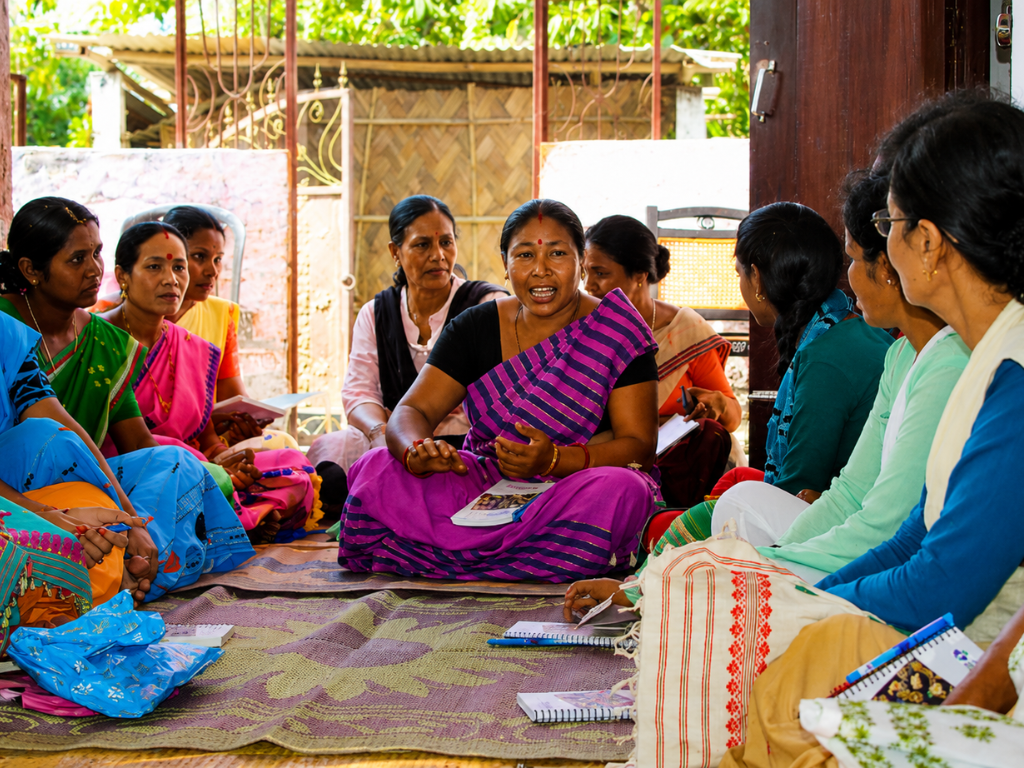
Rigorous M&E increasingly employs mixed methods, integrating quantitative and qualitative data collection. Quantitative surveys enable statistical inference and generalization to broader populations, while qualitative methods—focus group discussions (FGDs), key informant interviews (KIIs), and case studies—provide contextual depth and capture beneficiary perspectives not anticipated in indicator frameworks.
Outline India's Monitoring and Evaluation Capabilities
Primary data collection infrastructure across 27 states and 4 union territories
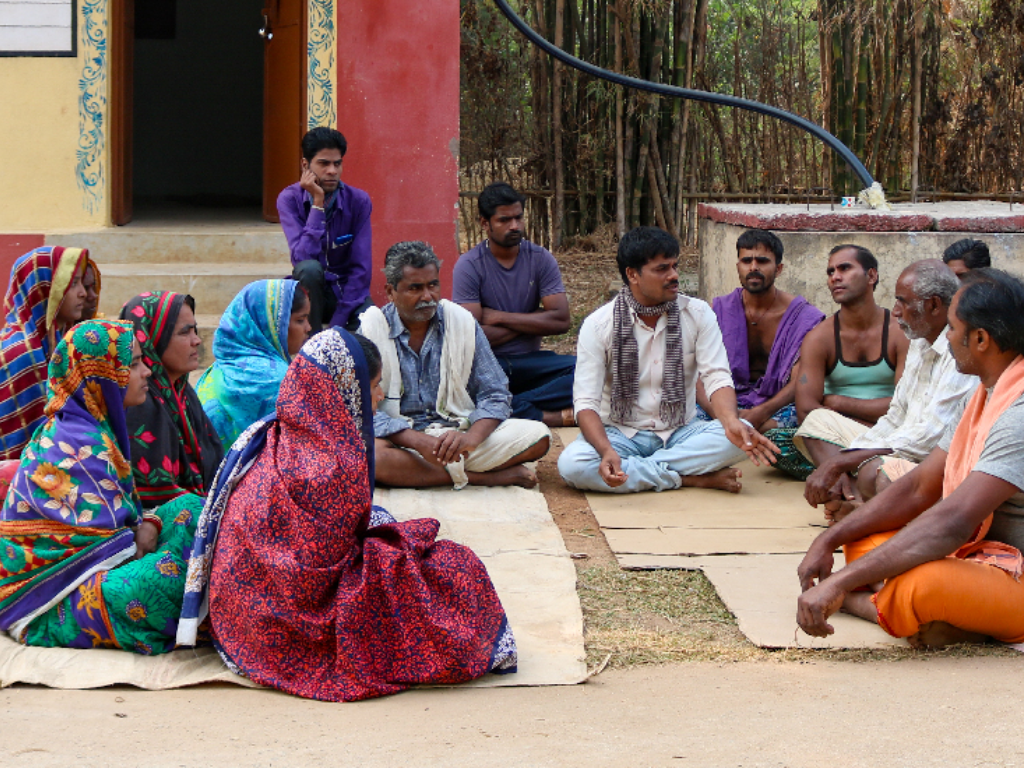
Outline India maintains field enumeration infrastructure across 27 states and 4 union territories, enabling data collection in diverse geographic, linguistic, and cultural contexts, with an enumerator network fluent in regional languages including Hindi, Bengali, Tamil, Telugu, Marathi, Gujarati, Kannada, Malayalam, Odia, Punjabi, and multiple tribal languages.
Data collection employs computer-assisted personal interviewing (CAPI) and computer-assisted telephone interviewing (CATI) platforms, enabling real-time data transmission, automated skip logic, GPS-tagged survey locations, and multimedia capture. Field teams receive standardized training on survey instruments, informed consent procedures, and data security protocols, including piloting of survey instruments and role-play exercises for sensitive topics.
Sectoral expertise: health, education, livelihoods, WASH, governance
Outline India's M&E portfolio spans multiple development sectors. In health and nutrition, the firm has conducted impact assessments of maternal and child health interventions and community health worker models, measuring outcomes such as antenatal care utilization and stunting and wasting prevalence.
In education, Outline India has evaluated teacher training programs, remedial education interventions, and digital learning platforms, employing learning assessments and classroom observation protocols.
Livelihoods and financial inclusion evaluations examine program effects on income generation, employment, and economic resilience, using household consumption modules and time-use surveys.
WASH evaluations measure access to improved water sources, sanitation facility construction and usage, and handwashing behavior, incorporating direct observation protocols to verify infrastructure functionality alongside self-reported survey data.
In governance and service delivery, the firm conducts citizen feedback surveys, public expenditure tracking, and service delivery assessments, often combining facility surveys with user surveys and administrative data analysis.
Survey scale and sample representativeness
Outline India's evaluations are characterized by statistical rigor and sample sizes sufficient to detect policy-relevant effect sizes with adequate statistical power. Sampling strategies are tailored to evaluation objectives—probability-based sampling, stratified random sampling, or multi-stage cluster sampling—enabling generalization to defined populations. Sample representativeness is verified through comparison to census benchmarks or representative national surveys such as the National Family Health Survey (NFHS) or National Sample Survey (NSS), with survey weights applied where necessary.
Methodologies Employed in Our M&E Practice
Quasi-experimental designs: difference-in-differences, PSM, RCTs
Impact evaluation seeks to estimate the causal effect of a program by establishing a credible counterfactual. Randomized controlled trials (RCTs) address this challenge by randomly assigning units to treatment and control conditions, creating statistically equivalent groups. RCTs are most viable when programs are being scaled gradually or when demand exceeds supply, enabling randomized selection among eligible beneficiaries.
Where randomization is not feasible, difference-in-differences (DID) estimation compares changes over time in treatment areas to changes in comparison areas, netting out common trends. Outline India tests parallel trends assumptions using pre-program data and employs extensions such as synthetic control methods when standard DID assumptions are violated. Propensity score matching (PSM) addresses selection bias by constructing a comparison group whose observable characteristics closely resemble those of program participants.
Sector applications
Financial inclusion evaluations assess access to savings accounts, credit, insurance, and digital financial services, measuring uptake and downstream effects on economic welfare. Outline India has evaluated self-help group (SHG) programs, microfinance interventions, and financial literacy initiatives.
WASH evaluations assess sanitation coverage, latrine construction and usage, open defecation behavior, and drinking water access and quality, combining household surveys, direct observation, and water quality testing—recognizing that infrastructure construction does not by itself guarantee sustained usage.
Energy evaluations examine access to clean cooking fuel and off-grid renewable energy systems. Climate adaptation evaluations assess programs promoting drought-resistant crops and flood preparedness. Urban development evaluations assess housing and urban sanitation programs, urban transport, and slum upgrading initiatives.
How to Select an M&E Firm in India
Selecting an M&E partner is a consequential decision that shapes the quality of evidence generated and the credibility of results for external accountability.
"Technical capacity and sectoral experience:" Prospective partners should demonstrate fluency in evaluation methodologies appropriate to the evaluation questions, articulate threats to validity and mitigation strategies, and provide realistic assessments of what can and cannot be concluded from proposed designs.
"Field infrastructure and data collection reach:" Firms with established enumerator networks and prior field presence in evaluation areas can mobilize teams more quickly and leverage local knowledge. Linguistic capacity is essential for evaluations in tribal or minority language areas.
"Review of past evaluation reports:" Strong reports clearly articulate evaluation questions, describe evaluation design and its limitations, present findings with appropriate statistical inference, and acknowledge limitations rather than over-claiming. Ethics protocols—informed consent, data confidentiality, and independent ethics review—reflect the firm's commitment to respondent welfare.
Impact Evaluation vs. Process Evaluation: When to Use Each
Impact evaluations (summative evaluations) assess the causal effect of a program on intended outcomes, answering whether the program works and by how much. Process evaluations (formative evaluations) assess implementation fidelity, delivery quality, and reach, answering whether the program is being delivered as designed and to whom.
Impact evaluations are warranted when there is genuine uncertainty about program effectiveness and when feasible comparison or control groups can be constructed. Process evaluations are valuable when implementation fidelity is uncertain and understanding implementation variation is essential for interpreting outcomes. Outline India conducts both impact and process evaluations, often integrating approaches within single evaluation projects—for example, combining a randomized measurement of learning outcomes with classroom observations that assess technology usage and implementation barriers.
Why Organizations Choose Outline India for M&E
In-house research and analytics team
Outline India maintains an in-house research team comprising economists, statisticians, public health specialists, education researchers, and sector experts. This technical capacity enables full-service evaluation support—from evaluation design and instrument development through data collection, analysis, and report writing—under unified technical leadership.
The firm's analytical capabilities include statistical and econometric techniques—difference-in-differences estimation, propensity score matching, instrumental variables, regression discontinuity, and multilevel modeling. Analytical transparency is maintained through reproducible code and documentation of analytical decisions.
Commitment to data ethics and respondent protection
Data ethics and respondent protection are foundational to Outline India's research practice. All evaluations obtain informed consent from respondents, with consent processes tailored to literacy levels, linguistic contexts, and cultural norms. Special protections apply to vulnerable populations, with appropriately adapted consent procedures.
Data confidentiality is maintained through de-identification protocols, secure data storage with access controls, and data sharing agreements that specify permitted uses. Research ethics review is obtained from institutional review boards or internal ethics committees for evaluations involving human subjects.
---
Rigorous monitoring and evaluation generates the evidence necessary to assess program effectiveness, improve implementation, and demonstrate impact to stakeholders. As development programming in India becomes more ambitious in scale and more accountable to beneficiaries, the demand for credible, independent evaluation partners continues to grow.




David Angel Makel
IT ConsultantIt is a long established fact that a reader will be distracted by the readable content page looking at its layout point of using normal