
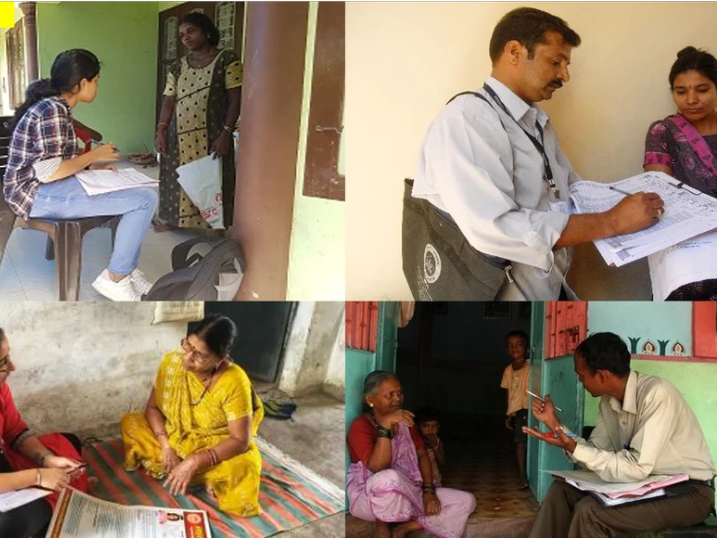
When development sector evaluations require rapid, geographically dispersed data collection with verifiable quality protocols, Computer-Assisted Telephone Interviewing (CATI) represents a methodologically rigorous alternative to field-based enumeration. Outline India, founded in 2012, operates CATI infrastructure purpose-built for large-scale development research: a dedicated call facility with native-speaker capacity across Hindi, Tamil, Bengali, Marathi, Gujarati, Kannada, Malayalam, Telugu, Odia, Punjabi, Assamese, and English, real-time quality monitoring dashboards, and documented response rate protocols across 27 states and 4 union territories.
This infrastructure supports baseline assessments, endline evaluations, beneficiary tracking panels, and rapid assessments where telephone modality is methodologically appropriate—particularly in contexts requiring swift turnaround, cost-efficient coverage of dispersed populations, or follow-up waves in mixed-mode longitudinal designs. Our approach emphasizes transparency in sampling frame construction, systematic documentation of call dispositions using AAPOR response rate definitions, and integration with broader M&E frameworks combining CATI with CAPI fieldwork and qualitative methods.
What Is CATI and When Is It the Appropriate Data Collection Method?
Definition and methodological use cases
Computer-Assisted Telephone Interviewing (CATI) is a survey administration technique in which trained enumerators conduct structured interviews via telephone, with responses entered directly into digital survey software that manages skip logic, validates inputs in real time, and records metadata on call duration, attempts, and outcomes. Unlike CAPI conducted face-to-face, CATI eliminates travel time and enables supervisors to monitor live calls, providing immediate feedback at scale.
CATI is methodologically appropriate when research designs prioritize geographic coverage efficiency, sampling frames include reliable contact numbers, and mobile phone penetration within the target population is sufficiently high to minimize coverage bias. Typical use cases include beneficiary satisfaction surveys, post-training follow-ups assessing retention and employment outcomes, rapid needs assessments during crises, and follow-up waves in panel studies where baseline contact information has been collected through prior CAPI rounds. The mode is particularly suited to shorter questionnaires (typically 15–30 minutes) with closed-ended items.
Advantages over CAPI and PAPI for specific research designs
Compared to field-based enumeration, CATI offers several advantages under specific conditions. Speed of deployment is significant: once sampling frames are finalized and instruments programmed, telephone surveys can commence within days rather than weeks, bypassing logistical challenges of enumerator travel and field coordination.
Cost efficiency scales favorably for geographically dispersed samples, since CATI surveys incur marginal costs per additional call rather than per-interview travel costs. Centralized quality control represents another structural advantage—supervisors can listen to live calls, provide real-time corrective feedback, and audit recorded calls systematically, capabilities difficult to replicate across dispersed field teams.
Limitations and sampling considerations
CATI methodology carries well-documented limitations that must inform study design. Coverage bias arises when target populations have unequal access to mobile phones or when sampling frames exclude households without active numbers, potentially excluding marginalized populations critical to development research. Post-stratification weighting can partially adjust for known demographic imbalances.
Non-response bias poses additional challenges—telephone surveys typically achieve lower response rates than in-person interviews due to higher refusal rates and difficulty establishing rapport without face-to-face interaction. Sampling frame quality directly determines the feasibility and rigor of CATI studies: list-based sampling drawing from beneficiary rosters or program databases with verified contact numbers offers greater precision and response rates than Random Digit Dialing (RDD), which generates numbers algorithmically but yields high rates of non-working or wrong numbers. Mode effects also merit consideration when comparing CATI results to prior CAPI baselines or designing mixed-mode studies.
Outline India's CATI Infrastructure and Technological Capabilities
CATI software platforms and data security protocols
Outline India's CATI operations employ licensed survey software platforms integrating telephony systems with survey logic, enabling seamless administration, real-time data capture, and encrypted transmission to secure servers. Our systems support complex skip patterns, range checks, and inter-item consistency validations embedded at the question level.
Data security protocols are designed to align with recognized standards for sensitive research data. All data transmissions are encrypted, personally identifiable information (PII) is stored separately from survey responses and linked only via anonymized identifiers, and role-based access controls ensure that enumerators access only assigned cases, with audit logs documenting all data access and modifications.
Multilingual call capacity and geographical reach
Our CATI facility is staffed with native-speaker enumerators across 12 major Indian languages, recruited based on linguistic fluency, educational qualifications, and prior survey experience, enabling us to field multilingual surveys without relying on translated scripts read phonetically. This linguistic capacity supports primary data collection across 27 states and 4 union territories, from metropolitan centers to rural districts. For projects requiring regional dialects, we recruit specialized enumerators and conduct targeted training.
Real-time monitoring dashboards and supervisor oversight
Our CATI infrastructure includes real-time monitoring dashboards displaying key performance indicators—calls attempted, completed interviews, refusals, non-contacts, and enumerator-level productivity—enabling supervisors to identify bottlenecks and reallocate resources. Supervisors conduct live call monitoring for a portion of interviews per enumerator per day, assessing adherence to informed consent scripts and question wording fidelity without interrupting the interview. Call recording capabilities enable systematic quality audits post-fieldwork.
Quality Control Protocols for CATI Surveys
Enumerator training and standardization procedures
CATI enumerator training spans 3–5 days depending on questionnaire complexity, combining didactic instruction on survey methodology and interviewing techniques with intensive mock interview practice. Standardization is reinforced through recorded mock interviews that supervisors review collectively with trainees, and inter-rater reliability assessments ensure consistent interpretation of response categories before live fieldwork commences.
Live call monitoring and back-checks
Live call monitoring operates throughout fieldwork, with supervisors silently joining calls to assess protocol adherence and data entry accuracy, stratified across call outcomes to detect systematic issues. Back-checks—independent re-contact of a systematic sample of respondents to verify interview completion and validate key responses—constitute an additional quality layer, with discrepancies between original and back-check responses triggering investigation and, where patterns emerge, re-fielding of affected cases.
Response rate optimization and callback protocols
Maximizing response rates is essential for minimizing non-response bias. Outline India employs systematic callback protocols: initial calls are attempted across varied times of day to accommodate diverse respondent schedules, with non-contacts triggering scheduled callbacks before cases are coded as final non-contacts. Call dispositions are systematically coded using AAPOR-compliant categories, and response rates are calculated transparently using standard AAPOR formulas, reported alongside cooperation and contact rates in field reports.
Scale and Sectoral Experience in CATI Data Collection
Outline India has deployed CATI infrastructure for surveys ranging from small rapid assessments to larger multi-state evaluations, with parallel interviewing across multiple CATI stations and multilingual enumerator pools enabling simultaneous fielding in multiple states. Survey complexity varies by sector, spanning questionnaires of 15–45 minutes with multi-level skip logic and multimedia integration such as audio consent recordings.
In "health" we have conducted beneficiary satisfaction surveys assessing maternal and child health program delivery and facility assessments interviewing health workers about supply chains and service utilization. "Education" sector CATI projects include post-training follow-ups with teachers assessing knowledge retention and parent surveys evaluating school satisfaction. "Livelihoods and employment" evaluations frequently employ CATI for beneficiary follow-ups tracking employment status and income changes among vocational training participants. "Governance and civic engagement" research leverages CATI for citizen perception surveys and service delivery feedback mechanisms.
Our CATI clients include multilateral donors, foundations, government ministries and departments, bilateral development agencies, and research institutions commissioning M&E and impact assessments, typically requiring verifiable data quality, transparent documentation of fieldwork protocols, and timely delivery aligned with reporting deadlines.
Methodological Considerations and Reporting Standards
Sampling frame development and weighting adjustments
Rigorous CATI studies begin with sampling frame construction that determines population coverage and ultimately the validity of inferences drawn from survey data. We collaborate with clients to evaluate available sampling frames—program beneficiary lists, administrative databases, prior survey contact rosters—assessing completeness and alignment with target population definitions. Post-stratification weighting adjusts for differential non-response and known sampling frame coverage gaps, using external benchmark data from Census or NFHS to construct weights aligning achieved sample distributions with population parameters.
Informed consent protocols for telephone interviews
Ethical conduct of telephone surveys requires informed consent procedures adapted to the constraints of non-face-to-face interaction. Our CATI protocols begin each call with a standardized consent script identifying the research organization, explaining survey purpose, and emphasizing voluntary participation with the right to refuse or discontinue at any time. For projects requiring written consent due to funder or IRB mandates, we employ hybrid protocols combining telephone screening with subsequent delivery of detailed consent forms.
Documentation and metadata provided to clients
Outline India delivers comprehensive field reports alongside cleaned datasets, including detailed response rate calculations using AAPOR definitions, call logs, enumerator performance metrics, and quality assurance summaries. Metadata files include complete survey specifications: questionnaire instruments, variable codebooks, sampling weights with construction methodology, and data cleaning logs.
Integrating CATI with Mixed-Methods Research Designs
Development sector evaluations increasingly adopt mixed-methods frameworks that triangulate evidence across data collection modes. In baseline-endline impact evaluations, CATI often serves as a midline monitoring tool: following an in-person baseline that collects detailed outcome measures and contact information, telephone midline surveys track interim outcomes at a fraction of the cost of repeated CAPI waves.
Panel studies with multiple follow-up waves employ CATI for routine tracking between costlier in-person waves. Rapid assessments responding to policy changes or emergent evaluation questions leverage CATI's speed and geographic reach, and CATI also complements qualitative methods by enabling efficient screening and recruitment of interview or focus group participants.
---
Partner with Outline India for CATI Data Collection
Outline India's CATI infrastructure, multilingual capacity, and quality assurance protocols provide development sector clients with verifiable, methodologically rigorous telephone survey data at scale. Whether your research design requires rapid baseline data collection, cost-efficient follow-up waves in longitudinal evaluations, or geographically dispersed beneficiary tracking, our documented response rate protocols and transparent reporting standards support data quality appropriate for impact assessment.




David Angel Makel
IT ConsultantIt is a long established fact that a reader will be distracted by the readable content page looking at its layout point of using normal